The World Cup is coming to Atlanta and the minority founders who are winning this summer aren’t buying a single ad.
Inside this article:
- The “Gap Day” Secret: How to perfectly time your promotions so your automated systems do the heavy lifting, allowing you to actually rest and protect your energy on match days.
- The Billion-Dollar Ad Trap: Why trying to outbid global brands for local ad space is the fastest way to drain your budget (and how to win without buying a single ad).
- The “Marketing Hangover”: Why chasing temporary tourists and accidentally ghosting your local regulars is the most expensive mistake you can make this summer.
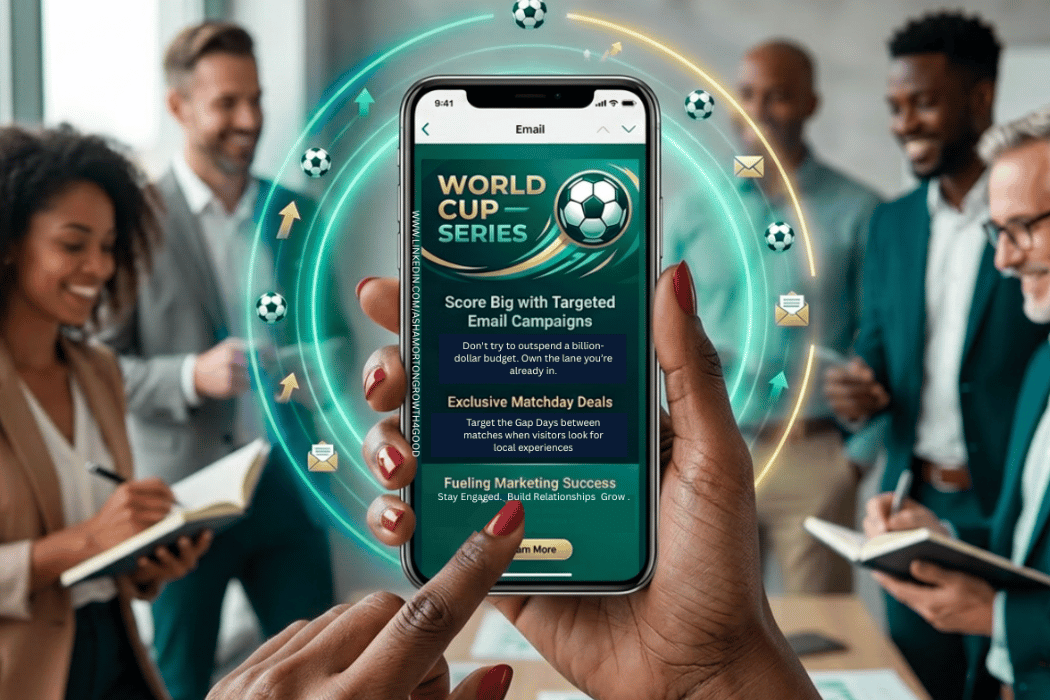
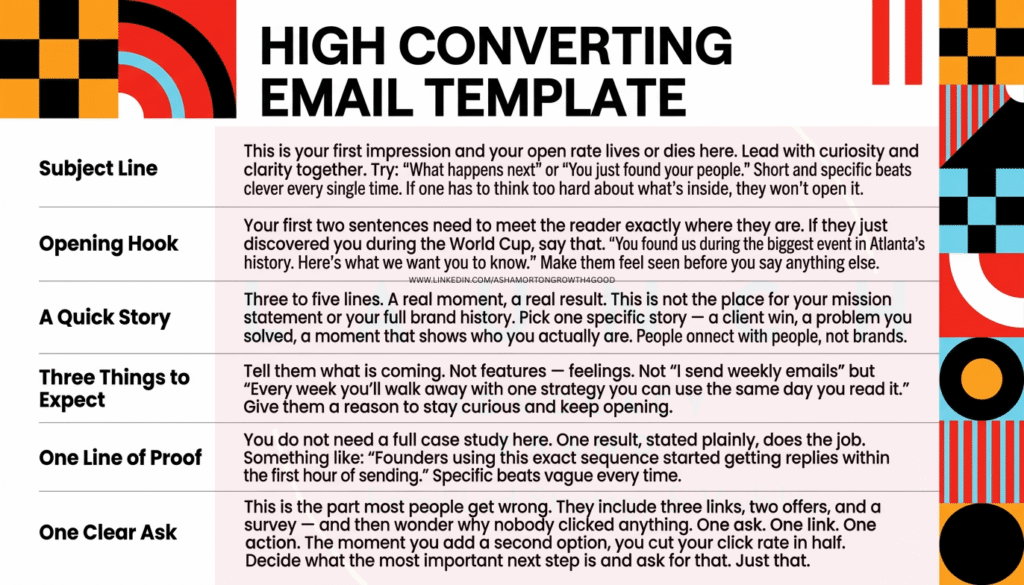
- Building Connection Infrastructure (High Converting Email Template Included): How to use the one algorithm you actually own (your email list) to turn a simple QR code scan into a warm, automated welcome sequence.
Nobody in the marketing world wants to say this out loud, so I will.
The World Cup is not the time for small and mid-sized businesses to compete with corporations. But it is the perfect time to own the lane you’re already in.
When one of the most watched events on the planet lands in your city, it brings something most small and mid-sized business owners mistake for opportunity, but is actually a trap.
There’s a story I come back to whenever I see a founder trying to outspend someone with ten times their budget. David didn’t beat Goliath by picking up his sword. He used something small, precise, and completely underestimated. And he won.
Your email list is that stone.
But before we get there, I need to walk you through exactly what is about to happen in Atlanta.
Why Buying Ads During the World Cup Is a Losing Bet
Here’s a quick breakdown of how digital ads actually work on a normal day, because this part matters. When you run a Facebook or Instagram ad, you’re entering an auction. Let’s say you set a $200 budget. The platform uses that money to show your ad to the people most likely to care about what you’re selling.
A local restaurant buys ads to fill tables on a slow Tuesday. A nonprofit runs ad campaigns to get new donor sign-ups. The system works because the auction is manageable. You’re competing against other small and mid-size businesses in your area, and your $200 holds its own.
Now picture that same auction during The World Cup event in Atlanta.
Adidas just activated a global ad campaign. A McDonald’s campaign went live at the same time. Every major FIFA sponsor is now targeting the same Atlanta zip codes you’re in with budgets that would make your jaw drop. Suddenly your $200 is sitting at a table with people who brought $2 million.
Your ad doesn’t disappear. It just gets buried. What used to get you 400 impressions might now get you 40, at the same cost. The audience didn’t shrink. The competition for their attention just got a hundred times more expensive overnight.
“You cannot outbid a billion-dollar budget. Meet your audience in their inbox, that’s the low hanging fruit.”
Asha M., Founder, Launch Advocacy Brand
Here’s the good news: you were never supposed to play that game. The founders who win during a mega-event are not the ones who spent the most on ads. They’re the ones who showed up in the right place, quietly, consistently, and directly. That place is the inbox.

Engage With The Customers You Already Have
Now, let’s talk about consumer behavior during a major event that most marketing advice skips right over. When a mega-event comes to town, there are two types of people in your city: tourists who just arrived, and locals who live there.
And here’s what most small business owners get completely wrong. They spend all their energy chasing the tourists and accidentally ignore the locals. Your regular customers, the people who have been showing up for you consistently, the one’s who know your name, are actively avoiding the city during big events. The traffic is a nightmare. Parking is impossible. The crowds are overwhelming. They are watching the matches from their couch, ordering delivery, and waiting for things to calm down.
So here is what happens when you ignore them for thirty days to chase visitors who may never come back: Your regulars feel forgotten and the relationship goes cold. Now your customer engagement has dropped, and you’re stuck trying to rebuild trust with the people who were already in your corner.
I call this the Marketing Hangover. This is when you exhaust your budget and your team, and wake up on the other side with nothing left to show for it. It is one of the most expensive and preventable mistakes in small business marketing.
The people already sitting at your table are the ones who will still be there after the big event. Don’t make them feel like they lost their seat. Here is the reframe I want you to hold onto: retention is the strategy. It always has been.
The founders and nonprofit leaders who plan to use popular events like the World Cup as a reason to deepen their existing relationships, instead of abandoning them, come out of the summer stronger than they went in. Every single time.
The Only Marketing Channel Nobody Can Take From You
Let me break down something that sounds simple but changes everything once you really understand it. Every social media platform you use is borrowed land, which means the platform owns your followers. They decide how many of them see your content on any given day. They can change the algorithm, increase ad costs, or shut down entirely, and there is nothing you can do about it.
But your email list? That belongs to you. No algorithm can bury it, and no mega-event can make it more expensive to reach your audience. When someone gives you their email address and asks to hear from you, you have a direct line to that person.
This is why the most important thing you can do right now is build an email system that manages your relationships.
Your email system is going to be a series of automated emails that welcome new people into your world, boost community engagement, and keep your business communicating consistently, despite what is happening in the background.
During the World Cup, Atlanta foot traffic is going to be unlike anything this city has seen. People are going to walk past your business, pick up your card, scan your QR code. Something is going to spark their interest.
The question is: what happens in the 48 hours after that moment?
If the answer is nothing, if they walk away and never hear from you again, that moment is gone forever. You just met someone who was interested, and you let them disappear. But if a simple QR code drops them directly into a warm, automated welcome sequence? That visitor becomes a contact. That contact becomes a customer. That customer becomes the kind of community member who tells everyone they know about you long after the World Cup is over.
Email Is The Only Algorithm You Own
Build the email system first so you can test your strategy in advance. The welcome sequence does not have to be long or complicated. It just has to feel human, be specific to your brand, and show up consistently.
This format works because it treats your new subscriber like a person who just walked through your door, not a name on a list you’ll get to eventually. When this exact sequence was put to work for a client, the results came back fast. Replies started rolling in and four meetings were scheduled. All from one automated series that ran 24 hours around the clock.
The Gap Day Secret: Time Your Moves Around the Matches
Here is a theory for you to test. Tourists do not explore the city on match days. On game day, they are at the stadium, in the fan zones, watching the match. The neighborhoods outside the action actually get quieter. If you are pushing hard on match days, you are spending energy competing for an audience that is not there.
Focus on what I like to call the “Gap Days,” which are the days between matches when visitors are looking for something real to do. These are the days they will plan to visit a good restaurant, a local shop, in search of an experience they cannot get at the stadium. Those Gap Days are going to be your best windows.
Here is what a Gap Day looks like for a prepared founder: you send the email, highlight the in store experience, and launch the limited offer, or the community event that makes a visitor feel like a local for one afternoon. You show up when the competition is resting because they burned everything on match day. You don’t have to show up every day. You just have to show up on the right days.
And on the match days themselves? That is your rest day. Let your email sequences run in the background. Let your welcome series do the relationship-tending while you recover your energy for the next push. This is what it means to build a business that works for you.
Here is your action step: pull the World Cup match schedule right now and put the Gap Days on your calendar. Plan your email sends, your in-store events, and your community moments around those windows. Build everything before June so your system is already running before the first visitor ever scans your QR code.
The founders who plan around the game day schedule will out-perform the ones who just react to the moment. Every time.
You Already Have Everything You Need
The biggest mistake I see minority founders make during a mega-event is trying to fight a battle that was never theirs to win. The founders who win this summer are not going to be the ones who spent the most on ads. They are going to be the ones who spent the spring building a list, warming up a community, and setting up a system that keeps running whether they are at their desk or not.
Ready to Build Your Connection Infrastructure?
This article was written by Asha Morton, founder of Launch Advocacy Brand, an email-led strategy firm that helps mission-driven founders and nonprofits build systems that keep relationships from going quiet.
Free strategy and resources: www.growengageme.com
Founder-to-Friend Email Templates: ashamgrow.gumroad.com/l/ravlyf]