Inheriting a Legacy, Building a Brand
In 2007, Stephanie Hickman’s uncles were sunsetting a concrete company they’d been running since 1967. After spending a prior 25 years in the utility, law, and lobbying space as an executive, while also watching the country’s current infrastructure strain, Stephanie saw a different foundation worth building on with her family’s business. She knew it would be complicated: fixing the issues happening across the country for both utilities and power. She also knew that it was a billion-dollar market, and none of that work was happening without concrete.
So, like any trailblazer, Stephanie traded a corner office for a concrete company and got to work. Stephanie stepped into a new industry, concrete, with open arms. How did she grow a decades-old family shop into a company tracking massive contracts, in a new market it hadn’t quite served yet? How did her previous career set her up to succeed? And how does scaling impact a brand that’s still building credentials of its own? Let’s get into it.
More than a business to run
Legacy, it makes a family business different from any other. And in Stephanie’s case, she had two things under her belt. The reputation she’d earned herself and the legacy she’d just inherited from her family. “When you take over a family business, you are carrying generations along the journey with you,” Stephanie says. For her, that meant carrying her family’s work forward, evolving it into something they’d never considered. Compliant, reliable concrete work serving the power/utilities sector the way STEPHANIE wanted it to run.
But carrying a legacy forward and actually breaking into a new industry are two very different things. What gave her a shot at both, was something she’d built long before 2007.
The reputation she brought with her
When it comes to switching careers, Stephanie emphasizes walking into new rooms with a clear understanding of what you’ve already built.
“I was able to bring my utility industry credibility with me,” she says. That’s a true personal brand working hard—transcending industries. Because Stephanie knew people across the country and understood where the industry was headed, while professionally she may have been considered “new in the space,” her personal brand wasn’t starting from zero. Far from it in fact. And she kept cultivating it. That’s investment. Personal brand is capital you can cash in on.
Stephanie accepted leadership roles in construction groups while staying active in the utility circles where she was already considered a notable figure. The company took on jobs outside the industry and built a strong portfolio to show it could perform safely, handle utility-scale projects, and hold its own with larger companies. It also subcontracted under established firms to build its own track record directly within the industry. One project at a time.
However Stephanie also understands better than most, where reputation stops. Many times, it helps get us in the door. The rest of success is on the business itself, specifically its infrastructure.
Getting in the door isn’t the same as being ready to be in the room
Eventually, a Fortune 200 client was interested in what Stephanie was building at Trice Construction Company. At that point in time, Stephanie’s reputation alone couldn’t make her company ready to actually handle the work that came with winning a contract of that size. The reporting, the cash flow, the 120-day revenue cycle, it was too big of a gap for her reputation to close. So what did she do? She got to work AGAIN.
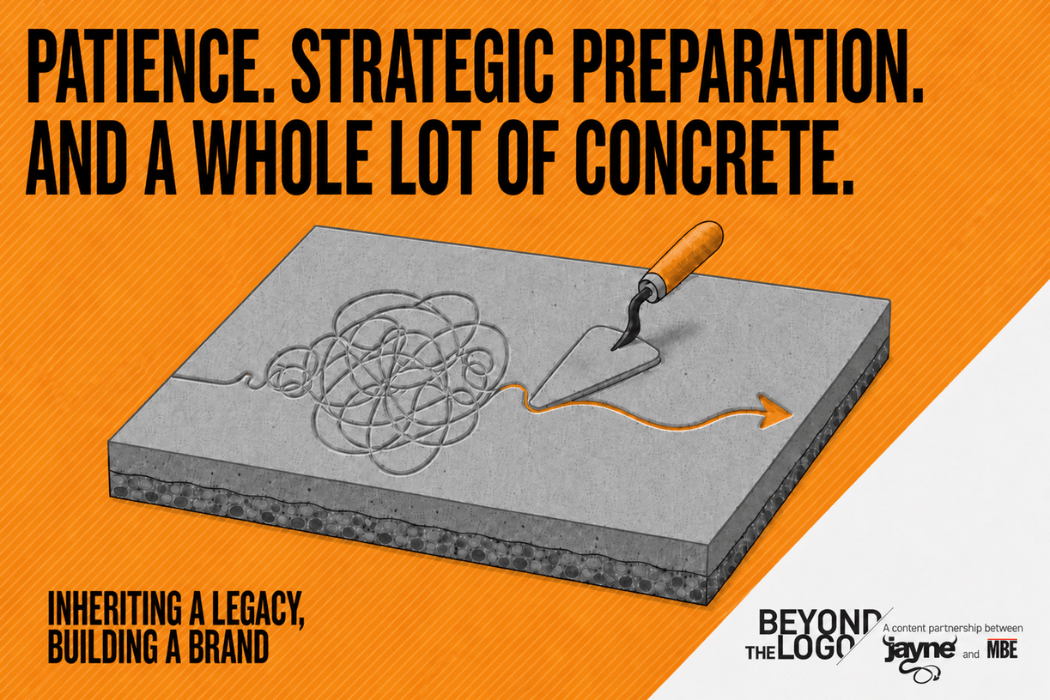
Closing a daunting gap with patience, strategic preparation, and a whole lot of concrete—literally. And part of closing that gap was also understanding what not to take on.
Stephanie credits her son for the perspective here. “Addition by subtraction,” they say. The process of walking away from potentially keystone work, because keeping it would actually cost more than it yields.
Takeaways
Stephanie’s story has a few lessons for anyone taking over a business they didn’t start or even thinking of switching careers. People may notice you because of your past, but they stay because of what you deliver today. Being ready for a big client has less to do with the actual reputation and more to do with everything around it, reporting, cash flow, etc. And the most important lesson Stephanie left us with, don’t grow faster than the business can handle.
As we interviewed Stephanie and began sifting through her responses for this installment of Beyond the Logo, we came to realize she made this entire career switch look easy. Almost natural. But knowing your own value and getting it in front of the right people is hard. It’s hard even for people who are excellent at what they do, and it’s harder still in the middle of a big move, when you’re focused on delivering brand value amidst it all.
At Jayne, we work with leaders in these moments all of the time. Stepping into a new industry, taking over a company, growing into a bigger version of themselves—we help them build the path forward with a clear position.
Is something changing in your world? We have the evidence-based strategy that identifies the challenge and builds the path forward. contactus@jayneagency.com