The multi-unit franchise owner traded a high-paying corporate career for something better—a business she owns, a legacy she’s building with her daughters, and a mission to bring more entrepreneurs into franchising.
Toya Evans remembers sitting in a boardroom after a 21-hour workday—an early morning flight to the West Coast, a client meeting, and a turnaround flight home—and realizing that no matter how much she gave, her check stayed the same. The man who owned the company had just become a billionaire. She wasn’t. And she was exhausted.
“If I’m going to bet on somebody,” she thought, “I’d rather bet on myself.”
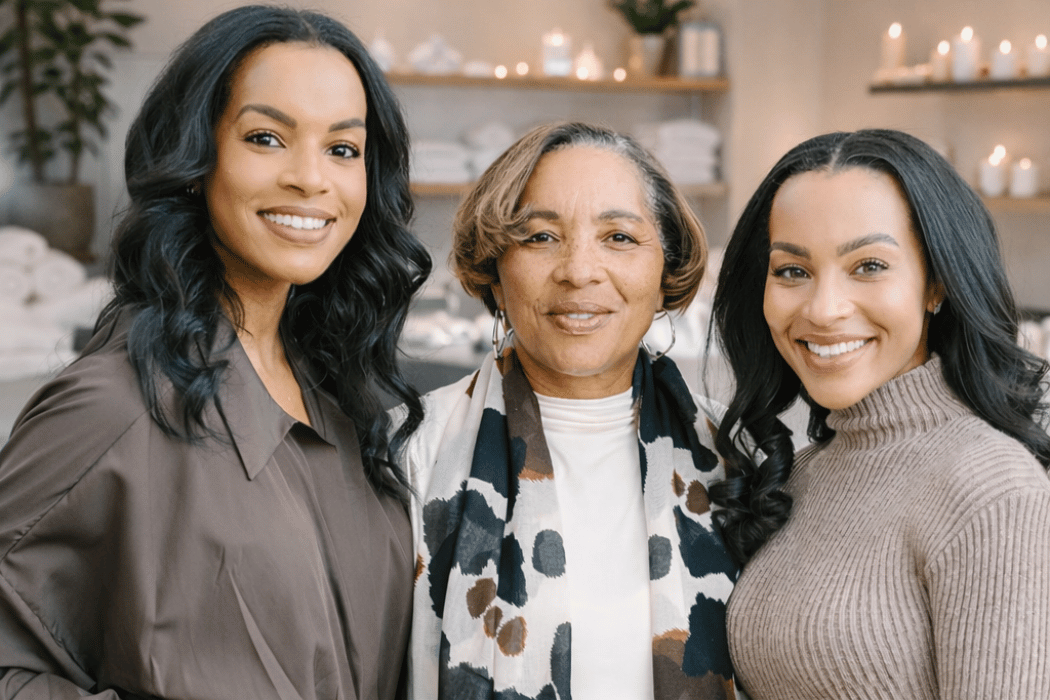
Today, Evans is a multi-unit franchise owner with three Hand & Stone Massage and Facial Spa locations and one VIO Med Spa. She runs these businesses alongside her two daughters, Chanel Grant and Lauren Williamson, building what she calls a “multi-generational legacy of business ownership.” She is also the president of the Black Franchise Leadership Council (BFLC), an organization dedicated to bringing more Black entrepreneurs into franchising. Her mission is simple: if she can do it, so can you, and she’s going to show you how.
The Number That Changed Everything
When Evans first walked into an International Franchise Association (IFA) trade show, she looked around a room of more than 4,000 people and counted fewer than 20 African Americans. That number, less than half a percent of the room, told a story that matched the national data.
Of the roughly 831,000 franchises operating across the United States, Black entrepreneurs own less than six percent. And when you remove celebrity investors like Bob Johnson, Sheila Johnson, and Shaquille O’Neal, who collectively hold hundreds of units, that number drops even further.
“If you think six percent is bad,” Evans says, “try taking out [people] that own multiple units. It’s really dismal.”
For Evans, those numbers are not a reason to give up. They are a reason to work harder. That is the driving force behind the BFLC, to grow representation by getting more Black entrepreneurs the education and mentorship they need to make the leap.
Why Fear Is the Biggest Barrier and What to Do About It
Evans has seen it happen dozens of times. A person spends months, sometimes years, learning about franchising. They take courses, ask questions, and attend seminars. They get all the way to the finish line. And then they stop.
“Oops, I’m not going to do it. I’m just going to stay at my job. It’s that security blanket,” Evans says, describing what she hears most. “But what this economy has shown us is that the job you think is so secure, it’s not that secure.”
She points to friends who have spent 18 months to two years applying for jobs and still come up empty. In that same window, she argues, they could have been building something of their own.
Franchising, Evans explains, removes much of the risk that comes with starting a business from scratch. You get a playbook. You get a support team. You get a brand that customers already know and trust.
“You’re in business for yourself, but not by yourself,” she says. “If you can follow rules, you can be a good franchisee.”
During the COVID-19 pandemic, Evans and her daughters used their downtime to create an online course called “So You Wanna Buy a Franchise.” The course covered everything from deciding whether entrepreneurship is right for you to selecting the right brand, finding a location, writing a business plan, and securing financing, including options beyond the Small Business Administration that many aspiring owners overlook.
If I’m going to bet on somebody, I’d rather bet on myself.
Toya Evans
Building a Family Business One Location at a Time
When Evans entered franchising, she knew one location would not be enough. She had a high-paying corporate salary to replace and so did her daughters. The math pointed clearly toward scale.
They started with two guiding criteria for every brand they considered: the business had to be somewhat Amazon-proof (meaning a service that people could not simply order online), and it had to be the number one or number two brand in its category. That thinking came from Toya’s earlier career at General Electric during the Jack Welch era.
“If your product couldn’t be number one or number two, he wasn’t investing in it,” she recalls. “We used those same criteria.”
Their first brand was Tropical Smoothie Café, then the number one in its category and new to the Maryland market. They grew to six locations, two traditional and four on military bases. When the brand sold out of available territory, they looked for their next move.
Hand & Stone Massage and Facial Spa came next, then number two in the wellness space behind Massage Envy. And the med spa expansion came when Toya’s youngest daughter, Lauren, who sold dermatology pharmaceuticals before joining the family business, spotted franchises entering the medical spa space at a trade show.
“Mom, we have to get into this. It’s a booming space,” Lauren told her. VIO Med Spa, the number one brand in that emerging category, became their fourth franchise brand.
The Walls Women Still Face in Franchising
Despite their success, Evans and her daughters have run into barriers that had nothing to do with their qualifications. The challenges, she says, tend to stack: woman first, Black woman second, and sometimes both at once.
One landlord told them he would not sign a lease unless their husbands co-signed as guarantors, despite the fact that their husbands were not on the LLCs and had no legal stake in the business. Evans and her daughters walked away.
They also walked away from a franchise brand they genuinely wanted to invest in after that franchisor refused to execute a deal without the husbands’ signatures on the agreement.
“Are we in the early 1900s?” Evans asked. “This is ridiculous.”
Access to capital presents similar roadblocks. Evans says lenders sometimes appear to have made their decision before a full application is even submitted. Her advice to other women is not to give up but to come prepared to exceed every expectation.
“Always come correct,” she says. “Do your research. Have your pro forma. Know your market. Know how you’re going to make money and pay your loan back. Don’t give them any reason to pause.”
Developing vs. Acquiring: The Lesson She Learned the Hard Way
Evans’ portfolio was built primarily through development, signing franchise agreements and building locations from the ground up. It works. But it is slow. From the day you decide to open a location to the day the doors open, the process of finding a site, negotiating a lease, and completing construction can take a year or more.
Acquisition, buying an existing franchise from an owner who wants to exit, offers a different path. You walk into a business that is already generating revenue, and that cash flow can help you qualify for additional financing to keep growing.
“In hindsight, we probably would have grown even faster if we could have done a mix of both, acquisition plus development,” Evabs says. It is a lesson she now shares with every aspiring franchisee she mentors.
Find Something You Love Because That Alarm Will Ring at 2 AM
Evans doesn’t sugarcoat the realities of franchise ownership. One of her Tropical Smoothie locations in Prince George’s County, Maryland, an intentionally underserved area she wanted to serve, was broken into four times. She has watched, via security camera, as thieves walked out with an 850-pound safe.
“When that alarm company calls at 2:30, 3 o’clock in the morning,” she says, “it better be something you enjoy. Because you’re going to get up and go.”
That is the core of her advice to anyone considering franchising: choose a business that speaks to you, not one you chose because someone else has it. With more than 831,000 franchise units across hundreds of industries, she says, there is something for everyone. Food. Fitness. Home services. Education. Healthcare. The list is long.
“It’s not that I have some secret sauce over here,” Evans says. “I’m just doing it. One foot in front of the other.”
The Bandwagon Effect She’s Counting On
From her years in marketing, Evans understands the power of seeing someone who looks like you doing something you thought was out of reach. When Black franchise owners show up, in articles, at conferences, in community spaces, the message lands differently.
“It’s the bandwagon effect,” she says. “If they can do it, I can do it too.”
That is why she keeps saying yes to every interview, every mentorship call, every speaking opportunity. It is why she helped build the BFLC. It is why she and her daughters created a course that answers the questions she once had no one to ask.
Toya Evans is a Black franchise owner who built her empire with her daughters at her side. But she has never been content to build alone. Every person she mentors, every door she refuses to let close quietly, that is how she measures the work.
She still hears her Delta Sigma Theta pledge motto in her head: “Find a way or make one.”
She chose to make one. And she is holding the door open for everyone behind her.