The son of Robert J. Brown, who created the Office of Minority Business Enterprise under President Richard M. Nixon, confronts new threats to the agency now known as the Minority Business Development Agency.
The views and opinions expressed in this article are those of the author and do not necessarily reflect the official views or positions of MBE magazine or its affiliates.
I look straight ahead, standing strong, but the ground beneath me is unsteady. I’m in good health, yet I feel as if I have an open wound—raw and torn, like bark peeled from a tree deep in the jungle.
Wiry thorns dig deeper with each step, their grip unrelenting. The pain never fades—only rips open again, like vines tightening, refusing to let go.
I feel the wound, but where is it? My head? My eyes? My feet? My body? My heart?
I can’t escape it. It’s not just physical—it’s deeper, almost impossible to trace. This constant sting infiltrates everything. It pulls at my thoughts, weighs down my body, clouds my vision, leaving me lost in a rainforest of uncertainty.
Not long ago, it still felt like many were moving through life as if everything were normal. The news cycles were lighter, the protests smaller. I found myself wondering: Where was the George Floyd-level urgency? The Women’s March energy? The deep, sustained rage?
But that numbness—maybe from burnout, maybe fear—finally began to snap, like a dry twig breaking free in the forest floor. Crowds are growing again. Voices are louder. People are starting to show up and stay.
Meanwhile, our democracy shows signs of erosion.
Not a sudden shift, but a slow, methodical unraveling. Authoritarianism often emerges not through chaos, but through the gradual normalization of cruelty and fear — masked as reform and efficiency, as many experts have warned.
We are beyond politics.
This is not about tax policy or procedural debates. Even the phrase “law and order” rings hollow when laws are bent to serve ideology over justice. Payroll cuts and rushed audits are cosmetic; deeper motives lurk beneath the surface.
One of the first actions of the current administration was to reverse the 1965 Civil Rights Executive Order signed by President Lyndon B. Johnson, a foundational document that set a national commitment to equity and inclusion. This reversal ignited a chain reaction across corporate America, chilling how diversity, equity, and inclusion programs are implemented and practiced.
Still, even in the densest jungle, light breaks through. And when it does, we must remember who we are—we must stand tall, even as the ground shifts beneath the tangled roots.
We must hold fast to the principles of equity, diversity, inclusion, and accessibility. We must refuse to be lulled into complacency or silence.
These values were not political for my family—they were personal.
I didn’t speak much with my father about the state of civil rights during my younger years. It wasn’t until President Obama’s second term that we began to touch on it again. By then, it felt like a towering tree—deeply rooted—now being cut down.
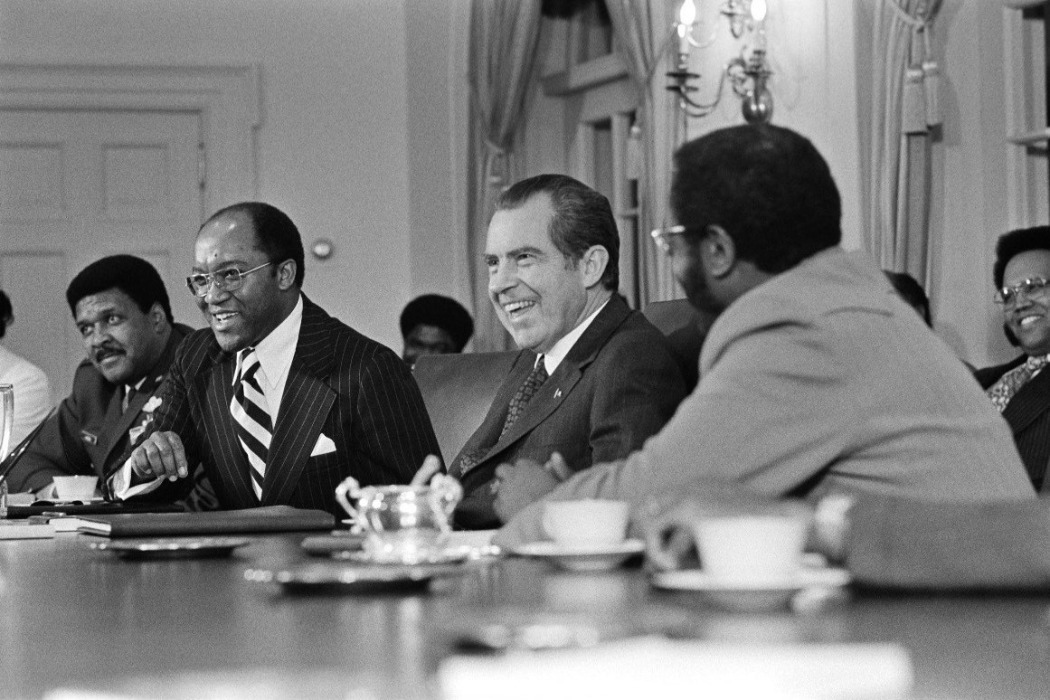
My father, Robert J. Brown, a Black man who was Special Assistant to President Nixon, led the creation of the Office of Minority Business Enterprise (OMBE), which later became the US Minority Business Development Agency (MBDA).
Established on March 5th, 1969, the agency’s mission was to support the growth and competitiveness of minority-owned businesses, including those owned by African-Americans, and other historically underrepresented communities.
Through the OMBE, my father provided access to capital, contracts, and markets — striving to break down barriers that had historically limited opportunities for minority entrepreneurs.
Unlike private sector advisors, my father operated inside government, using his position to shape policies that built a bridge toward lasting change.
It’s painful, now, to watch the agency he helped create face cuts and rollbacks.
The March executive order slashing the MBDA’s funding and staffing is more than a bureaucratic adjustment — it feels like an attempt to undo the progress generations have fought to build. The dismantling of civil rights advancements under the banner of “efficiency” or “anti-DEI” narratives echoes long, dangerous patterns in American history.
It is a reminder that even today, efforts toward inclusion are often met with fierce resistance.
- When military bases strip Black heroes’ names from history…
- When national museums are pressured to alter the telling of Black history…
- When government support for marginalized entrepreneurs is framed as “wasteful spending”…
We should all be concerned.
This is not about partisan lines. It is about whether we believe in the full dignity and equality of every human being.
I will not turn away. I will not be silent.
My father stood for progress, even when it was unpopular and risky.
I will do the same.
The wound I feel is real — but it is also a call to act.
If we speak up, show up and move together, with clear eyes and steady hands, we can cut through the thorns before the authoritarian overgrowth overtakes us completely.